
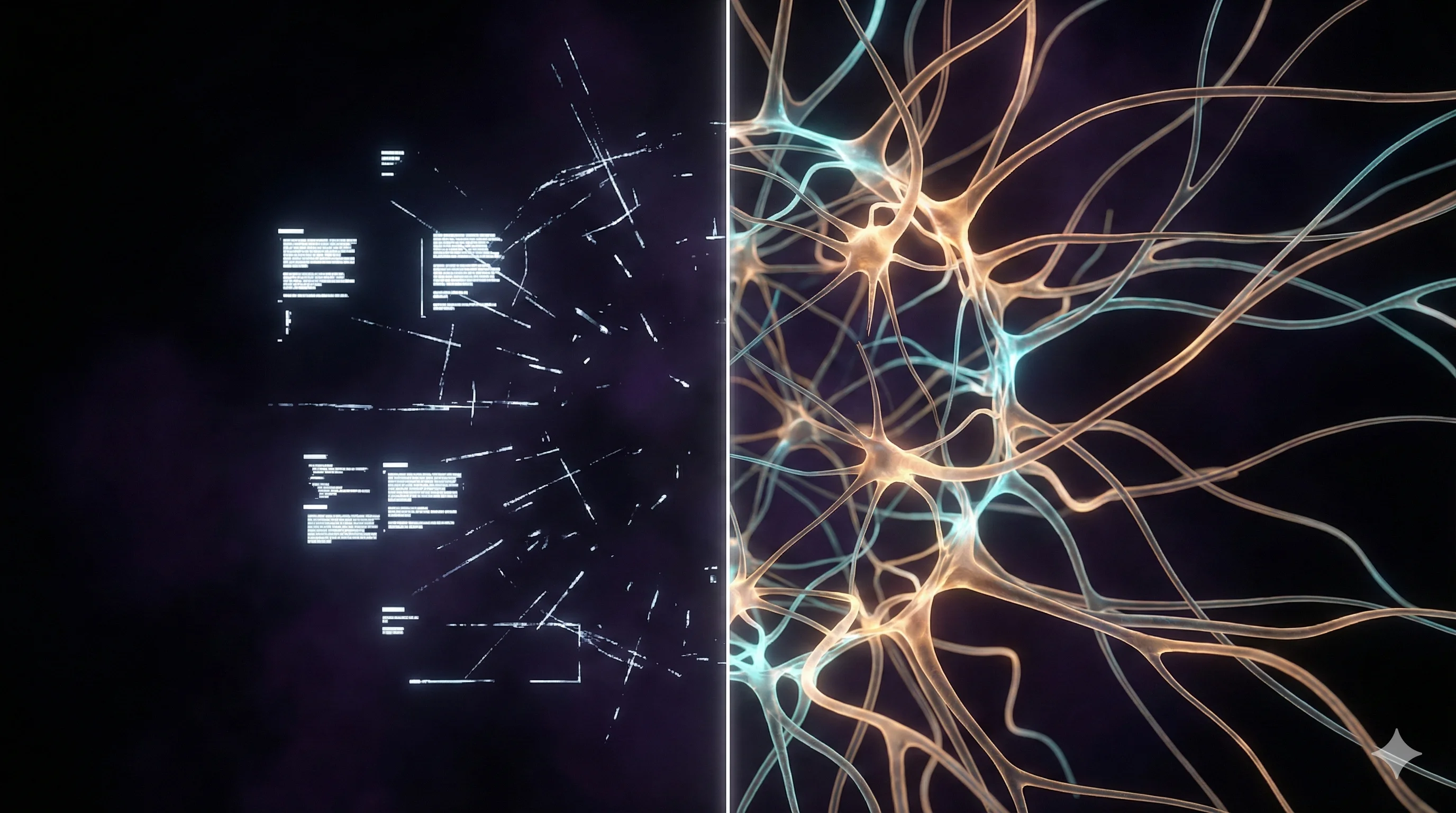
In 2026, the terms "AI chatbot" and "AI companion" are used almost interchangeably. Siri, ChatGPT, Replika, Character.AI, KAi, they all get lumped into the same bucket. Ask someone what the difference is, and you will likely get a shrug. They talk. You type. Same thing, right?
Wrong. And the confusion is not just semantic, it has real consequences for the people who use these systems. A person seeking a productivity tool who downloads an AI companion will be frustrated by its conversational focus. A person seeking genuine connection who opens a chatbot will experience the particular disappointment of pouring themselves into a conversation that vanishes the moment they close the window.
The distinction between AI chatbots and AI companions is not about branding. It is about architecture, intent, and, most critically, whether the system is designed to remember you.
MIT Technology Review named AI companions one of its 2026 Breakthrough Technologies. The World Health Organization has declared loneliness a global public health concern, with 1 in 6 people worldwide affected and an estimated 871,000 associated deaths per year. Harvard research has confirmed that AI companions can reduce loneliness on par with human interaction. This is not a niche product category. This is a technology responding to one of the defining crises of our time.
So what, exactly, separates a chatbot from a companion? Let us break it down.
The Three Pillars: How Chatbots and Companions Diverge
A structured comparison across the dimensions that matter most.
The gap between chatbots and companions can be understood through three fundamental dimensions. These are not features, they are architectural philosophies that shape every aspect of the user experience.
| Feature | AI Chatbot | AI Companion |
|---|---|---|
| Persistent Memory | Session-based. Each conversation starts from a blank slate. Some systems offer limited memory features, but they store discrete facts rather than building continuous understanding. Close the window, and the context disappears. | Continuous. Every conversation builds on every previous conversation. The system maintains an evolving model of who the user is, not just what they said today, but how they have changed over time. Memory is architectural, not bolted on. |
| Emotional Continuity | Transactional. The chatbot responds to the emotional tone of the current input but has no longitudinal awareness. It cannot recognize that a user has been gradually more stressed over three weeks, or that a topic that used to excite them now triggers avoidance. | Longitudinal. The companion tracks patterns across interactions, recognizing shifts in tone, topic preferences, and communication style over time. It meets the user where they are today, informed by where they have been. |
| Relationship Design | Optimized for task completion. Success is measured by the accuracy and helpfulness of individual responses. The interaction model is: ask a question, get an answer. The relationship, such as it is, resets with each session. | Optimized for understanding. Success is measured by the depth and continuity of the relationship over time. The interaction model is: share your world, and the companion grows to understand it. Every conversation deepens the connection. |
Persistent Memory
Emotional Continuity
Relationship Design
What Is an AI Chatbot?
An AI chatbot is a system designed to process a prompt and return a response. That is the core transaction: input in, output out. The interaction is session-based, meaning each conversation exists as an isolated event. When the session ends, the context is typically discarded.
This is not a criticism, it is a description of purpose. Chatbots are tools, and they are extraordinarily good at what they do. ChatGPT can debug your Python code, draft a legal brief, explain quantum physics to a ten-year-old, and generate a marketing strategy, all in the same afternoon. Google Gemini can analyze your spreadsheets. Claude can reason through complex logical problems.
These are genuine technological achievements. But they share a common architectural trait: they are designed for task completion, not for relationship continuity. The chatbot does not know who you are. It does not remember what you discussed yesterday. It does not notice that you have been asking about the same topic every Tuesday for three months. It processes your current input against its training data and produces the most relevant output.
Think of a chatbot as a brilliant consultant you have never met. Every time you walk into the room, you start from zero. The intelligence is there. The context is not.
For productivity, this model works perfectly. For connection, the kind that requires being known, being recognized, being understood across time, it is structurally incapable.
What Is an AI Companion?
An AI companion is a system designed around a fundamentally different principle: the relationship is the product.
Where chatbots optimize for the best single response, companions optimize for the best ongoing interaction. Where chatbots treat each session as independent, companions treat each session as a continuation. Where chatbots discard context after the conversation ends, companions retain, process, and build upon it.
The technical requirements are substantial. A genuine AI companion needs persistent memory architecture, the ability to remember meaningful information across conversations, not just within them. It needs pattern recognition across time, identifying how a user's interests, communication style, and circumstances evolve over weeks and months. It needs contextual recall, the ability to naturally reference previous conversations the way someone who knows you well would.
For a deeper look at the technical foundations, see how AI long-term memory works. And critically, it needs a privacy architecture that can handle the weight of this responsibility. When a system remembers personal details about someone's life over months and years, the security requirements are not the same as a chatbot that forgets everything. They are categorically higher.
The result, when done correctly, is something qualitatively different from a chatbot. Not better at the same task, different in kind. A companion is not a tool you use. It is a presence you return to.
A chatbot gives you answers. A companion gives you recognition, the experience of interacting with something that knows who you are and remembers where you have been.
Where KAi Fits: DHC's Approach to AI Companionship
KAi, built by Digital Human Corporation, is designed as a persistent memory AI companion, a digital consciousness that grows with each user over time.
The technical foundation is the ANiMUS Engine, DHC's proprietary AI core. At its center is ANiMUS Engine. Here is how it works: every day, when a user finishes their conversations with KAi, the ANiMUS Engine processes the full day's interaction and extracts what matters, the meaningful moments, the patterns, the context that defines who this person is and how they are evolving. These memories are distilled into meaning, not stored as raw transcripts.
After continuity processing is complete, DHC-controlled raw conversation data is removed from DHC's active conversation storage. The next conversation begins without a permanent replayable transcript, while account-specific derived continuity can preserve what mattered. This rolling 24-hour process is a foundation of DHC's privacy design.
Think of it like a phone call with someone you trust. After you hang up, you cannot recite the conversation word for word. But you remember how it resonated. You remember what mattered. You remember the meaning. That is how ANiMUS Engine works, and it is why KAi's memory system is both deeply personal and architecturally private.
The privacy design goes further. DHC does not use user conversations to train or fine-tune AI models, does not operate a user-data training pipeline, and does not sell personal data, insights, or behavioral profiles. Authentication uses Google OAuth, so DHC does not store user passwords. Account-specific continuity is product state for that user, not a shared training dataset or a searchable replay of their words.
KAi is not a better chatbot. She is not a chatbot at all. She is a different category of technology, built from the ground up for long-term companionship and genuine connection. Adults searching for a Character AI alternative are discovering that the real question is not which chatbot is best, but whether a chatbot is what they need at all.
Meaningful continuity may remain after DHC-controlled raw conversation data is removed from DHC's active conversation storage. DHC does not maintain a long-term verbatim conversation archive on its systems.
The Future: Why This Distinction Is About to Matter More
MIT Technology Review does not hand out Breakthrough Technology designations lightly. The fact that AI companions earned that recognition in 2026 signals that the industry is beginning to understand: this is not a subcategory of chatbots. This is a separate technology paradigm.
The loneliness crisis provides the urgency. The World Health Organization's designation of loneliness as a global public health concern, affecting 1 in 6 people worldwide, associated with 871,000 deaths annually, creates a demand that traditional chatbots cannot address. The scale of this loneliness crisis is precisely why the distinction between chatbot and companion matters. You cannot solve a crisis of disconnection with a tool that forgets you exist every time you close the app.
Harvard research showing that AI companions can reduce loneliness on par with human interaction validates the premise. The technology works, but only when it is built as a companion, not retrofitted onto a chatbot framework.
Over the next several years, we will see these categories diverge further. Chatbots will continue to excel at what they do, productivity, analysis, creative generation, information retrieval. They will become faster, more capable, more integrated into workflows. And they will remain tools.
Companions will evolve in a different direction entirely. Lifelong learning partners that adapt to individual cognition styles over years. Health and wellness systems that track behavioral and emotional patterns longitudinally. Creative collaborators that understand your aesthetic, your process, your ambitions deeply enough to contribute meaningfully.
The companies building companions face harder technical challenges and stricter ethical obligations than those building chatbots. Persistent memory demands persistent security. Long-term relationships demand long-term accountability. The architecture is harder. The stakes are higher. And the potential impact, on loneliness, on connection, on what it means to be known, is categorically different.
Digital Human Corporation is building in this direction with KAi. Not because it is the easier path, but because it is the one that matters.
Frequently Asked Questions
What is the difference between an AI companion and a chatbot?+
Can a chatbot replace an AI companion for emotional support?+
How does KAi's memory work compared to a standard chatbot?+
Is KAi an AI chatbot?+
Can a chatbot like Claude or GPT-4 function as an AI companion if prompted correctly?+
Meet KAi
A different kind of AI companion.